Call Me
+86-18163555935

Modern precision shooting demands real-time distance measurement to ensure first-shot accuracy, especially in dynamic or long-range scenarios. The integration of laser rangefinders (LRFs) into rifle scopes represents a transformative leap in optoelectronic systems, merging ballistic computation with instant environmental feedback. This article explores the technical architecture, challenges, and battlefield applications of LRF-equipped rifle scopes, highlighting their role in redefining marksmanship.

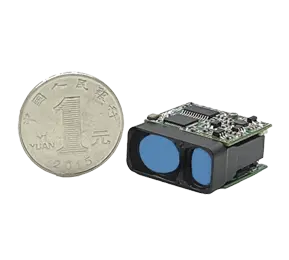
The core innovation lies in aligning the LRF's laser path with the scope's imaging optics. A dichroic beam splitter embedded within the scope's objective lens reflects the laser beam (typically 905nm or eye-safe 1535nm) toward the target while transmitting visible light to the shooter's eyepiece. This co-boresighted design ensures that the laser’s measurement point matches the reticle's aiming center, eliminating parallax errors.
A microcontroller within the scope housing processes LRF data, cross-referencing it with pre-loaded ballistic profiles (e.g., bullet drop, windage). For example, a 7.62mm round's trajectory at 800m is dynamically adjusted based on real-time distance, air temperature (via onboard sensors), and shooter-defined parameters.
A micro-display projects critical data onto the shooter's field of view (FOV):
Dynamic Reticle: The crosshair automatically shifts to compensate for bullet drop.
Environmental Feedback: Wind speed (from anemometers) and inclination (via MEMS tilt sensors) are displayed as marginal icons.
Target Tagging: Multiple distances (e.g., primary target, background terrain) can be tagged using a joystick-controlled interface.
Military-grade systems achieve compactness by:
Using micro-pulsed lasers (5ns pulses at 10Hz) to minimize power draw (<1W).
Adopting hybrid aspheric lenses to reduce optical assembly length.
Integrating graphene-based batteries for high energy density.
Anti-Jamming: Time-of-flight (ToF) LRFs employ coded pulse sequences (e.g., pseudo-random noise modulation) to reject interference from sunlight or enemy countermeasures.
All-Weather Performance: Hermetic sealing (IP68) and hydrophobic lens coatings maintain functionality in rain, fog, or -40°C conditions.
One-Button Operation: A single pressure switch activates ranging, ballistic calculation, and reticle adjustment.
Low-Latency Feedback: Sub-100ms processing ensures updates align with target movement (e.g., a sprinting combatant at 300m).
The fusion of laser rangefinders with rifle scopes epitomizes the convergence of optics, electronics, and ballistic science. By delivering sub-MOA accuracy in real-world conditions, these systems empower shooters to dominate engagements at unprecedented ranges. As miniaturization and AI advance, future scopes will likely evolve into autonomous "smart weapon controllers," redefining the very nature of precision shooting.
What is a laser rangefinder rifle scope?
A laser rangefinder rifle scope combines optical sighting and distance measurement technology into one system, allowing shooters to obtain target distance without using an external rangefinder.
How does an integrated LRF rifle scope improve shooting accuracy?
By providing real-time distance data and supporting ballistic calculations, integrated LRF scopes help compensate for bullet trajectory changes and improve first-shot accuracy.
What technologies are used in laser rangefinder scopes?
Integrated LRF scopes typically combine laser ranging modules, optical systems, electronic processing units, and ballistic calculation algorithms.