Call Me
+86-18163555935

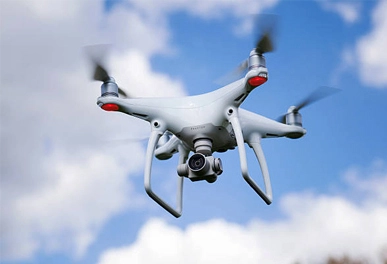
In daily life, drone gimbals are primarily used to stabilize cameras. To be precise, a drone gimbal is a support device that can be adjusted from multiple angles. As a specialized company in the UAV Gimbal Camera industry, Eyoung Tech is going to show you more about the world of gimbal.
As the requirements for image stability in film and television shooting become increasingly stringent, drone gimbals are also continuously evolving. Currently, in daily life, drone gimbals mainly come in three types: fixed gimbals, motorized gimbals, and stabilizing gimbals.
Fixed Gimbal
Typically used for shooting stationary objects. After mounting the camera on the fixed gimbal, you can manually adjust the angle according to actual needs to complete the shoot from a fixed position. For example, a camera tripod.
Motorized Gimbal
When using a fixed gimbal, the camera can only view a fixed area within its field of vision, creating significant monitoring blind spots.
If we add a motor to the fixed gimbal, users can control the motor to rotate, thereby expanding the gimbal's range of movement. Such motorized gimbals are generally used in surveillance cameras to enlarge the camera's observation area.
Stabilizing Gimbal
A stabilizing gimbal belongs to the motorized gimbal category. It features additional attitude control, allowing the object mounted on the gimbal to remain relatively stable.
On drones, we can install a stabilizing gimbal for the camera and pair it with sensors that detect attitude, known as gyroscopes. Using attitude control methods, it is possible to maintain stable imagery even during high-speed flights.
3-axis drone gimbals and 2-axis drone gimbals are common stabilization devices used in fields like photography and filmmaking. By affixing them to a camera or camcorder, they can effectively offset body movements, providing stable shooting results.
A 3-axis drone gimbal involves three axes mounted on motors to drive the elevation, horizontal rotation, and tilting movements of the gimbal, thus achieving stable shooting effects.
A 2-axis drone gimbal includes only two axes—the horizontal axis and the vertical axis—allowing for smooth movements in horizontal and vertical directions but not stabilizing tilting movements.
The main difference between a 2-axis and a 3-axis drone gimbal is the number of axes they independently control. In many industrial UAV systems, a 2-axis gimbal controls pitch and yaw, while a 3-axis gimbal also provides roll stabilization.
| Comparison Factor | 2-Axis Gimbal | 3-Axis Gimbal |
| Controlled axes | Usually pitch and yaw | Pitch, yaw and roll |
| Stability | Suitable for general inspection and observation | Better horizon control during complex movement |
| Weight and size | Generally lighter and more compact | Generally larger and heavier |
| Power demand | Potentially lower | Potentially higher |
| Integration | Simpler | More complex |
| Suitable applications | Inspection, mapping and lightweight UAV payloads | Filming, high-speed tracking and missions requiring full-axis stabilization |
A 3-axis gimbal provides more complete stabilization because it independently controls roll, pitch and yaw. A 2-axis gimbal may rely on the aircraft or digital image correction to compensate for movement on the remaining axis.
A 3-axis gimbal is more suitable when horizon leveling and stability during complex aircraft movement are essential. A 2-axis gimbal is often preferred for industrial inspection, observation and lightweight UAV applications where lower weight, compact size and simpler integration are more important.
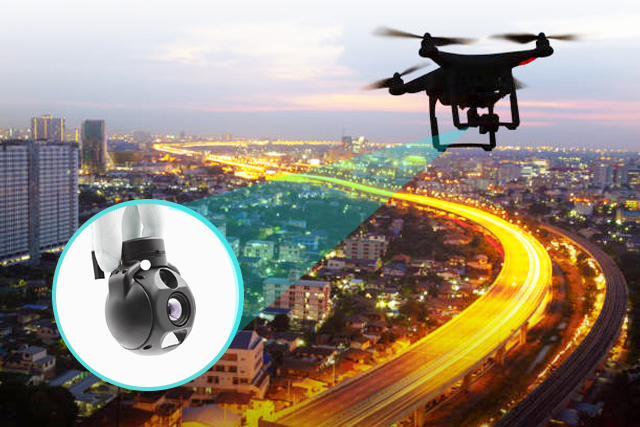
Although 3-axis drone gimbals provide additional stability, they are not always superior to 2-axis drone gimbals for industrial tasks. If a gimbal with a smaller size, lighter weight, optimized height and quality, and high adaptability to multiple drone platforms is needed, then a 2-axis drone gimbal is a very suitable choice. It provides the same level of image and video quality as a 3-axis drone gimbal but offers longer flight times. It can also be optimized for specific applications such as land surveying, 2D and 3D LiDAR mapping, and inspections of wind turbines, power lines, and bridges.
For example, when conducting bridge inspections, accessing the underside of the bridge can be a major obstacle. In such cases, a drone equipped with a front-facing two-axis gimbal allows the operator to get an unobstructed view from top to bottom. Hence, inspectors can see the span from below and the sides, collecting valuable visual data about these crucial areas of the bridge.
Yes. A 2-axis drone gimbal can provide sufficient control for inspection, observation, mapping and other missions where pitch and yaw movement meet the operational requirements. A 3-axis gimbal is more suitable when independent roll stabilization and consistent horizon leveling are essential.
Many industrial 2-axis drone gimbals control pitch and yaw, allowing the camera to look up and down and rotate horizontally. However, the axis configuration can vary by design, so buyers should always confirm the controlled axes and movement range in the product specification.
A 2-axis gimbal independently controls two rotational axes, while a 3-axis gimbal also controls the remaining axis, usually roll. This additional control improves horizon stabilization during aircraft banking but may increase the gimbal’s weight, size, power demand and integration complexity.
A compact 2-axis gimbal may reduce payload weight and power demand compared with a similar 3-axis system. However, actual flight time also depends on the aircraft, battery capacity, sensor payload, flight speed, wind conditions and mission profile, so the improvement cannot be determined by axis count alone.
A 3-axis gimbal is preferable when the mission requires independent roll stabilization, stable horizon control or clear imaging during complex aircraft maneuvers. Typical applications include professional aerial filming, high-speed tracking and missions with demanding image-stability requirements.
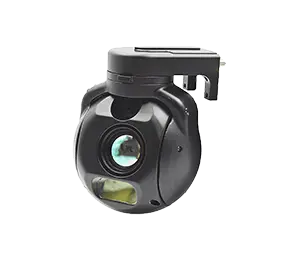
Yes. The number of stabilization axes does not directly determine the sensor configuration. Depending on the product design, a 2-axis gimbal can integrate visible-light cameras, thermal imaging sensors or combined EO/IR payloads. Buyers should compare total weight, interfaces, power consumption and UAV compatibility before selection.
oem laser rangefinder for smart device integration